This application is about creating time for me to research the potential for ethical ai/ml (machine learning) as a medium to help in future socially engaged co-production works, making a meaningful shift in my practice that can lead to future opportunities. The application asks the question can we use AI and ML for good and not be afraid of it or leave it to big fiance corporations to dictate what happens?
My developing my application will enable me to develop links in my creative practice between socially engage creative health biophilic (love of nature) art, Earth science and AI. To create new networks, skills and collaborators for my art production processes of future transdisciplinary creative AI/ML systems, that respond to the earth Crisis.
The grant from ACE will radically develop my creative practice into Machine Learning building, which would help relational socially engaged Biophilic (love of nature) co-production with communities with the emerging fields of entangled AI/ML.
‘We know from our work in the Creative AI Lab that artistic practices are exceptionally good at surfacing models for engagement with AI technologies–and not only engagement with the end user. More importantly, the production processes of the creative systems (including ML models) that artists build, highlight concerns that are resonant with those of the general public.’ Eva, Mercedes & the Creative AI Lab, Kings College London.
‘Jaime Jackson’s use of digital art in engaging children and young people on the topic of air quality was innovative. The use of image to video synthesis animation enabled a sense of collectivism to be developed by producing art work that amalgamated hundreds of drawings and written responses from workshops across ten schools in the West Midlands. This tied in with Jaime’s focus on climate anxiety where a balance was struck between informing children of risks to our environment and the sense that negative feelings can demonstrates care and collectively, change can be achieved. Schools unanimously valued the art work and were able to use this as a resource to continue conversations around climate change. It has been fantastic for so many children and young people to observe the creative practice of an individual working with this new tool that is often regarded as a challenge for artists rather than also an opportunity.’ Siobhan Sadlier Engagement Executive West Midlands Combined Authority
Feedback from Zafroon Bibi, a Year 6 teacher at Thornton Primary School. Birmingham: ‘Working with Jaime was an absolute pleasure. It was a way for our students to mirror and reflect on their environmental knowledge, presenting their thoughts innovatively, pushing boundaries on how we should raise awareness towards local and national sustainability and other environmental issues, such as climate change. The children developed the perspectives of real artists, rather than simply putting paint onto paper. Pupils came to understand art was not just a process that included drawing and painting, but rather an outlet of self-expression. A journey, where everyone is free to articulate themselves confidently. I strongly believe that with Jamie’s help, further opportunities to artistically express topical issues will arise, creating a community of awareness towards the changing world. Jaime created a wonderful opportunity for our students to tell their stories in an engaging and deep meaningful way.’
Feedback from National Lottery climate Action Fund on Jaime’s co-production work: ‘Thanks so much for taking the time to get in touch with us and sharing the wonderful zine. What a beautiful and moving thing those young people have created. I have shared the digital file with my team and we’re exploring featuring it at an internal webinar later in the year. Thank you again for sharing the amazing work of these young people.’ Hayley Wareham (She/her) UK Portfolio Officer
Project Management plan, the development will be in 4 phases:
- Mentoring by an AI Art curator.
- Joining and taking part in national and international AI art information exchange networks.
- Meeting in person with key specialists in the entangled AI Art sector.
- Bringing together of new awareness of the sector, skills and knowledge to create a plan for future work, creating and sharing a report on my findings.
Mentor: October 2026 start mentorship by Hannah Redler-Hawes and scope out the mentor sessions with Hannah , a UK-based curator and producer of international arts-led projects specializing in digital, immersive and art and technology / art and science collaborations, including in emerging fields of data and AI.
The list of actions and new contacts/networks for me below is not exhaustive, in this emerging field of ethical entangled AI responding to the Earth Crisis. It will develop during the course of my development period.
Networks: From October 2026 undertaken actions outlined below to create new networks I have not yet met or joined
Join AI for Individual Rights Human Rights Foundation newsletter
Join the Serpentine Arts Technologies network
Join Future art Ecosystems Newsletter
Join Creative AI lab
Join Art X Public AI a strategic briefing on public interest AI in the cultural sector
Join AI For Good AI for Good was established in 2017 by the International Telecommunication Union (ITU), the United Nations (UN) leading agency for digital technologies. The mission of AI for Good is to unlock AI’s potential to serve humanity through building skills, AI standards, and advancing partnerships.
Take part in October 10th 2026 Digital Factory Virtual Summit 2026 on line focus on platform innovation, AI, and digital maturity.
Join Nature Machine Intelligence high-quality original research and reviews in a wide range of topics in machine learning, robotics and AI. From Nature Portfolio is here to serve the research community by publishing its most significant discoveries—findings that advance knowledge and address some of the greatest challenges that we face as a society today.
AI Specialists from January 2027: AI Research lab/curators/ researchers visits/ new network building:
Department of Digital Humanities, KCL. The lab focuses on developing research and prototypes that further artistic experimentation with AI. Our aim is to expand the conversations around AI by offering a more nuanced vision and approach to the negotiation of its public value and interest. Through the lens of art-making, we are able to explore key questions with greater precision and specificity.
School of Advanced Studies University of London Dr Anna Milon – Project Story Machine An ML arts project funded by the Arts and Humanities Research Council and the Deutsche Forschungsgemeinschaft, is a collaboration between Hof University of Applied Sciences, Ludwig-Maximilians-Universität München, the University of Hertfordshire, the University of London, the University of Regensburg and the University of the Arts London.
University of Southampton Electronic Life, Lead researchers: Professor Sunil Manghani, Professor Ed D’souza to advance the conversation about Creative Artificial Intelligence, the project draws together research streams in AI and Arts and Social Practice in Art.
Kay Watson: Head of Arts Technologies Serpentine (Arts Technologies Future Art Systems)
Eva Jäeger: Curator and Creative AI Lead Serpentine (Arts Technologies Future Art Systems)
Hannah Andrews, creative director, executive producer and writer specialising in arts and advanced technologies at Google’s Arts & Culture Lab
Tao-Tao Chang Director of Digital Innovation in Arts British Council
Professor Mercedes Bunz Professor of Digital Culture and Society King’s College London, co founder of Creative AI Lab
Springer Nature provide technology-enabled products, platforms and services that help researchers to uncover new ideas and share their discoveries.
Liesbeth Venema Chief Editor, Nature Machine Intelligence publishes high-quality original research and reviews in a wide range of topics in machine learning, robotics and AI. Part of the Nature magazine network.
Dr Theresa Züger the Lead of the AI & Society Lab and the Impact AI research group at Alexander von Humboldt Institute for Internet and Society in Berlin. Theresa’s research is driven by her deep interest in the societal and political aspects of digital technologies and the narratives that accompany them.
Director of AI For Good Madisen Taylor helps technology, institutions, founders, investors, governments, artists, and communities coordinate around a shared future. She builds the ecosystems that turn powerful technology into public good. Her work spans AI governance, education, community, brand, and coalition-building.
AI Commons is a collective endeavor to enable universal access to the benefits of AI. Its mission is to help build an equitable, accessible, ethical, decentralized collaboration framework for AI based problem-solving for all. It aims to drive innovation in how AI is used for the common good.
Professor Stephenson is a distinguished geoscientist with the GeoGPT Research Group. He focuses on bringing artificial intelligence into the world of earth sciences
Intelligent Earth. The University of Oxford has established a new Centre for Doctoral Training (CDT) linked to The European Space Agency’s climate-related program, focused on artificial intelligence (AI), machine learning, Big Data, and environmental sciences. The UKRI AI Centre for Doctoral Training in AI for the Environment (The Intelligent Earth Centre) will train almost 100 PhD students to develop and apply cutting-edge AI technologies to tackle some of the most pressing environmental issues using AI through five closely connected themes of climate, biodiversity, natural hazards, environmental solutions and core AI research. Addressing a skills gap between AI and environmental science. Professor Philip Stier (Department of Physics), Director for The Intelligent Earth Centre, said: ‘Traditional, siloed training in environmental and data science has created a bottleneck for UK leadership in science, innovation, and entrepreneurship in this emergent space. Hence, The Centre will meet the urgent need for interdisciplinary training at the interface between the environment and AI.’
Existing cross-disciplinary arts, humanities and science networks I am part of, but have yet to explore in terms of AI/ML development:
Arts Council England Hollie Smith-Charles, Director, Creative Health & Change and New Technology & Innovation
Nature of Cities Festival (associate artist project consortium member) A global gathering of artists, scientists, and practitioners re-imagining how cities and nature thrive together.
Biophilic City Network (biophilic artist member, Birmingham) Biophilic Cities partners with a network of cities, scholars, and advocates from across the globe to build an understanding of the value and contribution of nature in cities to the lives of urban residents.
Basque Centre for Climate Change Professor Marcela Brunach (art-scientist collaboration artist) BC3 fosters co-production of knowledge relevant to decision making by integrating environmental, socioeconomic, and ethical dimensions of climate change Marcela specializes in collective decision-making under conditions of uncertainty.
Climate Psychology Alliance (associate artist and event co-producer) A UK wide network supporting the emotional relational and psychological dimensions of the climate crisis
University of Warwick School of Cross-Faculty Studies, Dr. Hita Unnikrishnan is an Assistant Professor at The Institute for Global Sustainable Development
Loughborough University Professor Peter Kraftl, Chair in Human Geography, Department of Geography and Environment, research on children’s geographies and interdisciplinary childhood studies. His work focuses on children and young people’s experiences of and interactions with environmental processes.
Sustainability West Midlands Member of the sustainability network which brings together a cross-sector network of more than 200 organisations in the private, public, HE education and community sectors. By harnessing this collective expertise, SWM supports members through knowledge exchange and peer learning, helping organisations address sustainability challenges while driving growth and innovation.
Background:
Understanding the contemporary digital cultures and concepts of AI/ML as a collaborative artist requires a foundation of knowledge, built by engaging in dialogue with contemporary researchers and collaborative experimentation with computational systems in ways that far exceed my present use of digital media. This research will join my practice with humanities, arts, science and engineering in Entangled AI. Which I will develop from the foundation of my practice as a painter and moving image film installation artist.
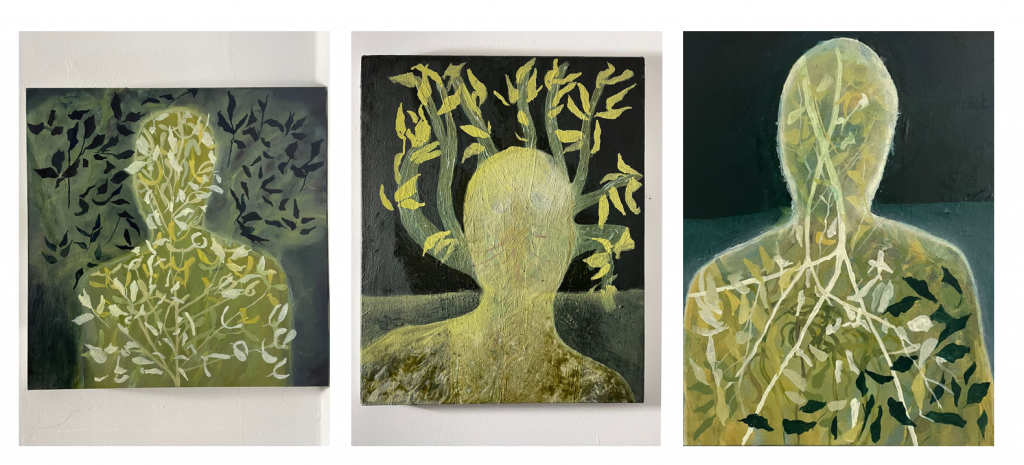
I have scoped the potential for AI/ML in digital co-production and socially engaged relational Biophilic practice, so I have a basic knowledge of the potential of AI as an artistic medium. I have used browser based generative multimedia image to video tools to develop moving image animations based on drawings of climate and nature created by children and young people. This technology uses the data set of the drawings to work out and create the images in between the drawings to make the animation. This has shown me that new tech can be used is ways that help people co-produce creative health nature connectivity artworks, there is so much more I need to find out. I have not yet spoken to an Entangled AI or ML scientist, researcher or engineer, this grant will enable me to develop my creative practice in ways I can’t do on my own with generative browser based AI. I know the potential for amazing ways of using ML to help people co-produce artworks that respond to the Earth Crisis through nature connectivity. I know through my art/science collaborations that AI is used to for modelling possible futures.
Working across disciplines:
My recent interdisciplinary and trans disciplinary work includes co-authoring the Basque Centre for Climate Change’s paper ‘Co-creating transformation and transforming scientists and artists co-creation’ for People and Nature magazine 2026.
Asset to support my DYCP: I have asked for a laptop capable building creative AI systems to explore in my development and research time. The legacy of the asset will be that I will use it to try out the new ways of working I develop in the future following this development period.
Alienware 18 Area-51 AI programing compatible laptop £2,949. Direct from Dell. This is the most competitive quote for the level of computer I need with the specs to run at this level. With a minimum requirment needed Graphics Card NVIDIA® GeForce RTX™ 5060, Memory 16 GB DDR5, and storage of 1TB.
Different quotes: